Design Strategy · Product Design · Institutional Alignment

LincolnCenter.org Homepage Reimagined

A digital front door as expansive, alive, and welcoming as the institution itself.

View working prototype
Organization
Lincoln Center for the Performing Arts
Status
In Development · Launching January 2027
Role
Product and Design Lead
Period
In development · January 2027 launch
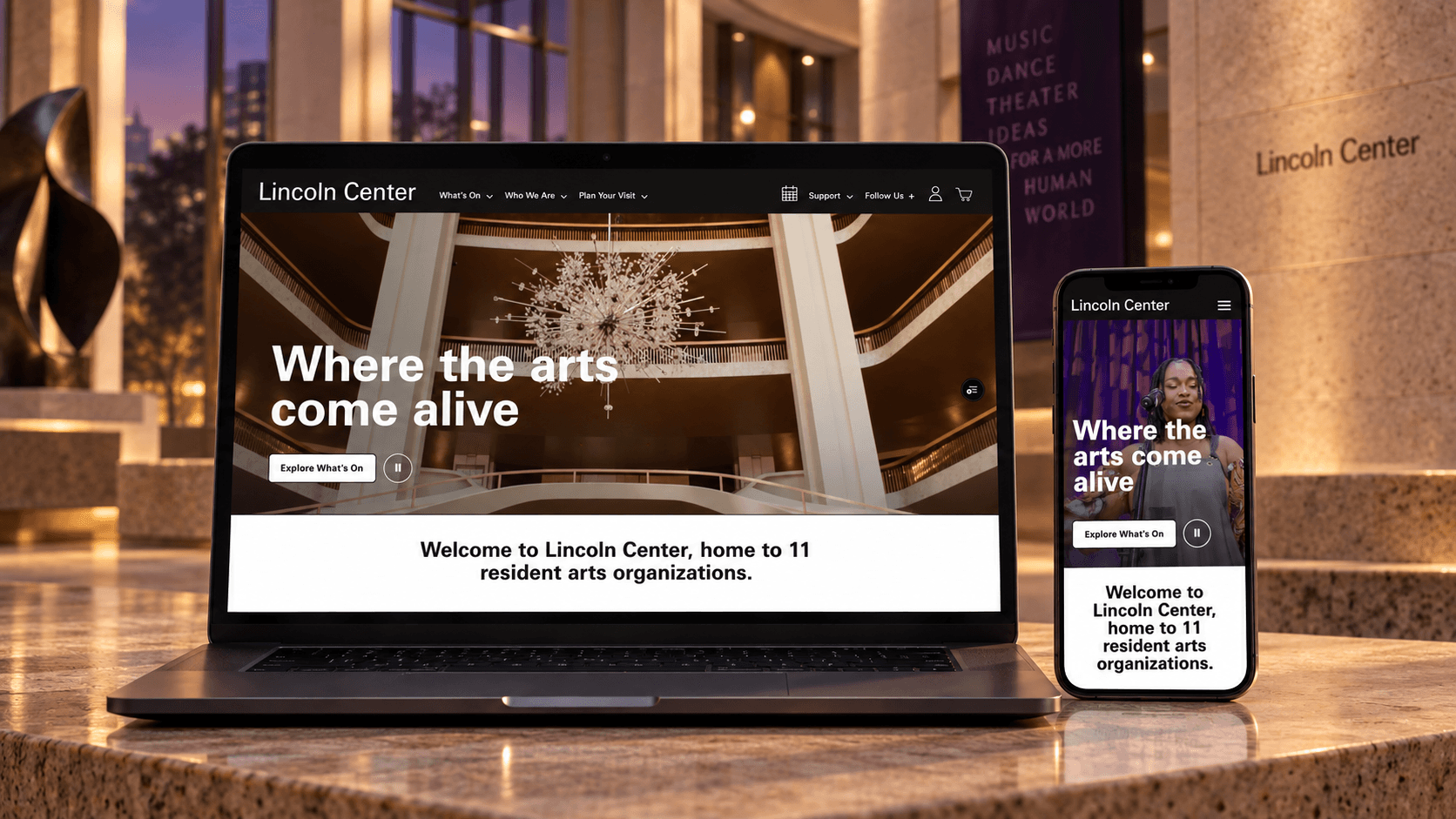
Lincoln Center homepage shown on a laptop and mobile phone in a warm performing-arts interior
One sense of arrival across desktop and mobile

Overview

A digital front door for an entire cultural campus.

Lincoln Center is a presenter, gathering place, civic institution, and home to internationally recognized Resident Arts Organizations. Its homepage needed to express that breadth while still helping someone answer a practical question: What can I experience at Lincoln Center?

I led the strategy, design, and development of a working homepage prototype that combines event discovery, institutional storytelling, public-space programming, organizational visibility, and clear audience pathways within a flexible component system.

The goal was not simply to modernize the page. It was to reconsider what Lincoln Center’s digital front door should do for audiences and for the institution itself.

The role of the homepage

Less traffic than the calendar, but a uniquely important job to do.

61K
active homepage users2025 calendar-year baseline
221K+
homepage interactions2025 calendar-year baseline
1.4M
outbound clicks to Resident Arts OrganizationsAcross LincolnCenter.org in 2025

My role

Product and Design Lead

I moved between institutional strategy, audience behavior, brand expression, content governance, interface design, and technical implementation to turn a broad organizational ambition into a shared product direction.

In collaboration withMarketing · Engineering · Advancement & Innovation · Programming · Brand · Communications · Visitor Experience · Accessibility

  • Define the homepage’s strategic role within the digital ecosystem
  • Plan and facilitate cross-functional stakeholder discovery
  • Translate institutional priorities into audience-centered opportunities
  • Analyze traffic and cross-campus referral behavior
  • Establish the experience principles and content hierarchy
  • Develop the information architecture and modular content system
  • Lead responsive visual and interaction design
  • Build the high-fidelity working prototype
  • Create executive narratives and lead stakeholder presentations
  • Connect the homepage to the calendar, visitor planning, institutional storytelling, and platform roadmap

Experience principles

Seven principles shaped the digital front door.

  1. 01Create a sense of arrival
  2. 02Lead with audience value
  3. 03Represent the whole campus
  4. 04Move naturally from inspiration to action
  5. 05Design for changing stories
  6. 06Build for the future brand
  7. 07Treat mobile as a primary experience

The challenge

An extraordinary institution without a sufficiently clear digital entrance.

What can I experience at Lincoln Center?

Lincoln Center presents its own programming while serving as the home of independent cultural organizations, each with distinct audiences, identities, websites, and ticketing systems. The campus also encompasses free events, festivals, education, public spaces, visitor services, restaurants, history, and major institutional initiatives.

Years of incremental additions had left the homepage without a strong narrative or hierarchy. Programming, institutional messaging, editorial content, and cross-campus visibility competed for limited space.

The page provided information, but it did not fully communicate the energy of arriving at Lincoln Center or the extraordinary range of experiences available there.
Discovery and alignment

Turning competing requests into a shared definition of purpose.

Because the homepage touches nearly every part of Lincoln Center, stakeholder alignment was itself a central design challenge. I organized discovery across programming, marketing, brand, communications, development, sponsorship, visitor experience, accessibility, and other institutional groups.

The process surfaced many valid demands for visibility, but also a shared ambition: communicate the breadth of Lincoln Center while making the overall experience easier to understand.

  • Event and program discovery
  • Resident Arts Organization visibility
  • Institutional and civic storytelling
  • Visitor planning and wayfinding
  • Sponsorship and partnership recognition
  • Content governance and publishing needs
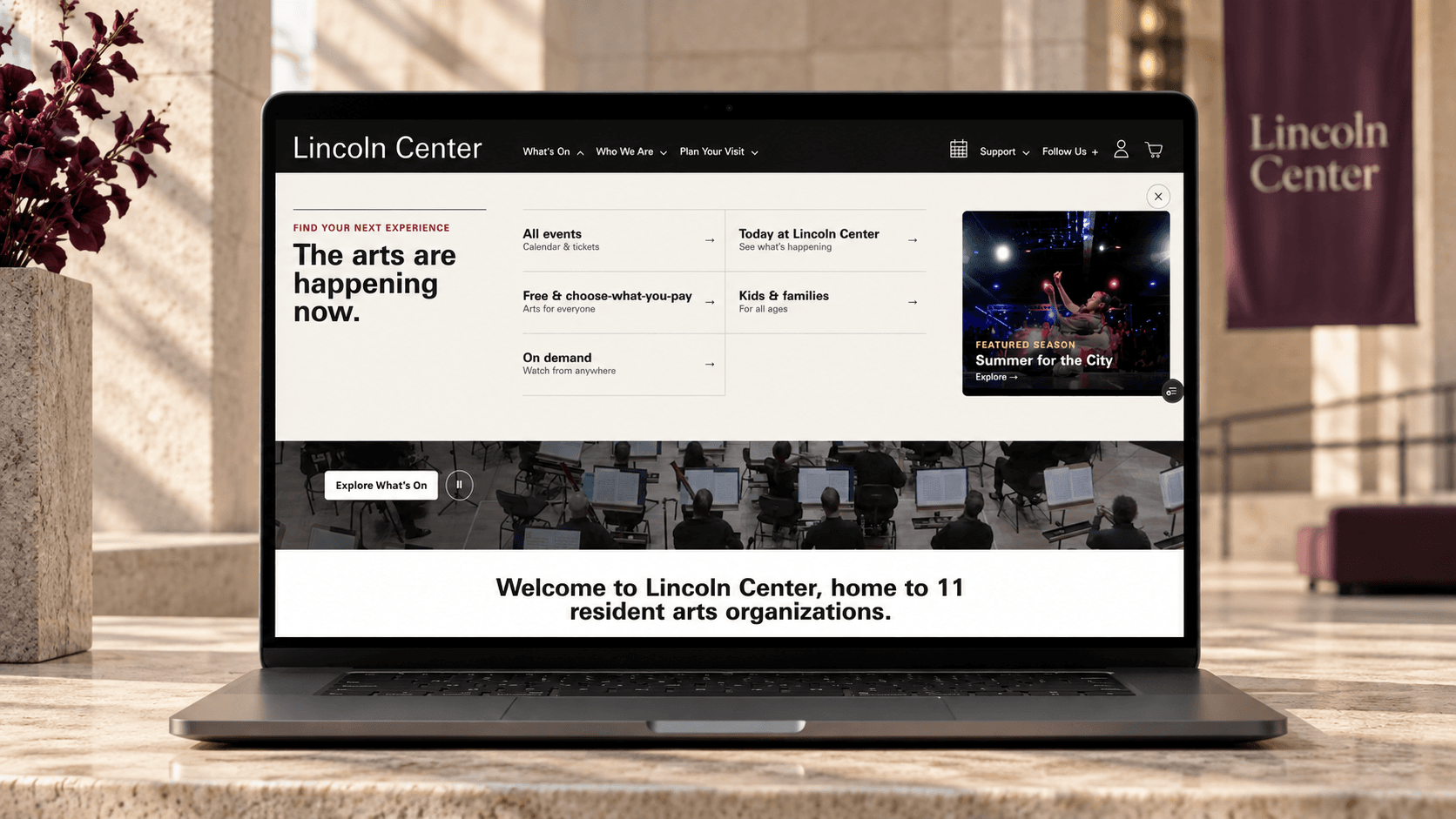
Expanded Lincoln Center discovery menu shown on a front-facing laptop
Audience pathwaysHigh-intent discovery remains immediately available inside a cinematic experience.

Reframing the product

From promotional billboard to connected audience journey.

A homepage organized around a rotating sequence of internal requests would always become crowded and difficult to govern. I reframed it around four durable audience and institutional responsibilities.

This gave every content area a clear role and created a better basis for prioritization: prominence would be earned through audience and institutional value rather than recency or organizational pressure.

  1. 01Create an immediate sense of place and possibility
  2. 02Provide pathways into current programming
  3. 03Represent the wider Lincoln Center campus
  4. 04Tell the stories that explain why the institution matters

The product vision

Cinematic enough to inspire. Structured enough to remain useful.

The reimagined homepage creates a more cinematic and editorial entrance to Lincoln Center’s digital ecosystem. A large visual opening establishes place, programming, and institutional energy before the page moves through discovery, campus representation, storytelling, and practical audience pathways.

Large moments of visual expression are balanced with concise content, recognizable calls to action, and clear connections to the Global Calendar.

  • Immersive full-width visual introduction
  • Direct integration with the Global Calendar
  • Flexible Featured Across Campus storytelling
  • Prominent Resident Arts Organization representation
  • Support for festivals, public programs, and major initiatives
  • Reusable components that can be rearranged and reskinned

Connected products

Inspiration hands off naturally to comprehensive discovery.

The homepage introduces what is possible; the calendar provides the depth to act on it.

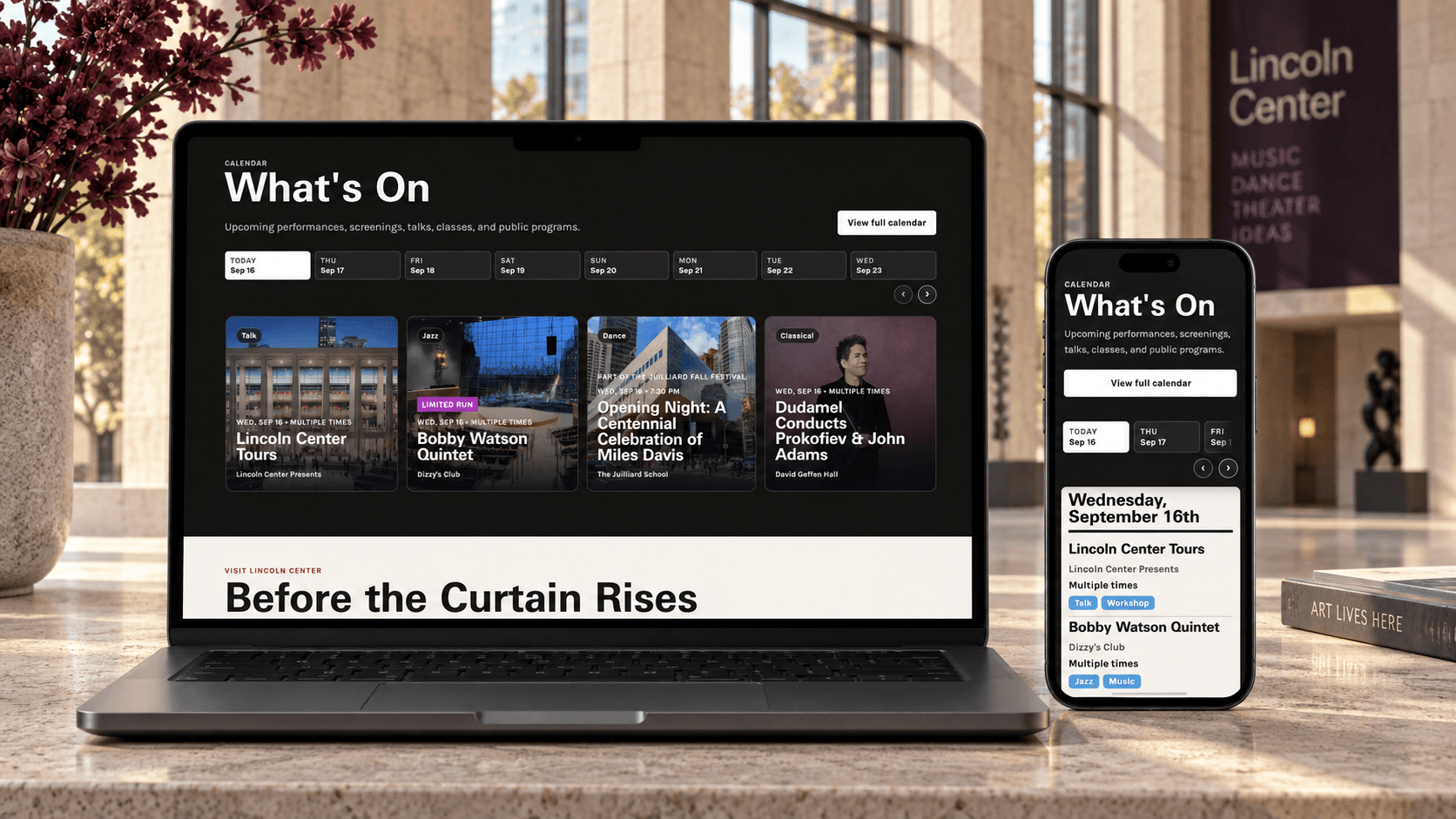
Connected What’s On experience shown on a front-facing laptop and mobile phone
Global Calendar integration across viewports

Featured Across Campus

Cross-campus visibility as an editorial system, not a logo strip.

Featured Across Campus creates room for performances, festivals, public experiences, exhibitions, education, Resident Arts Organization programming, and timely campus stories to coexist within one curated experience.

The concept helps audiences understand Lincoln Center as a connected destination while preserving attribution and meaningful onward pathways to the organizations presenting each experience.

Institutional storytelling

Making room for the stories that explain why the place matters.

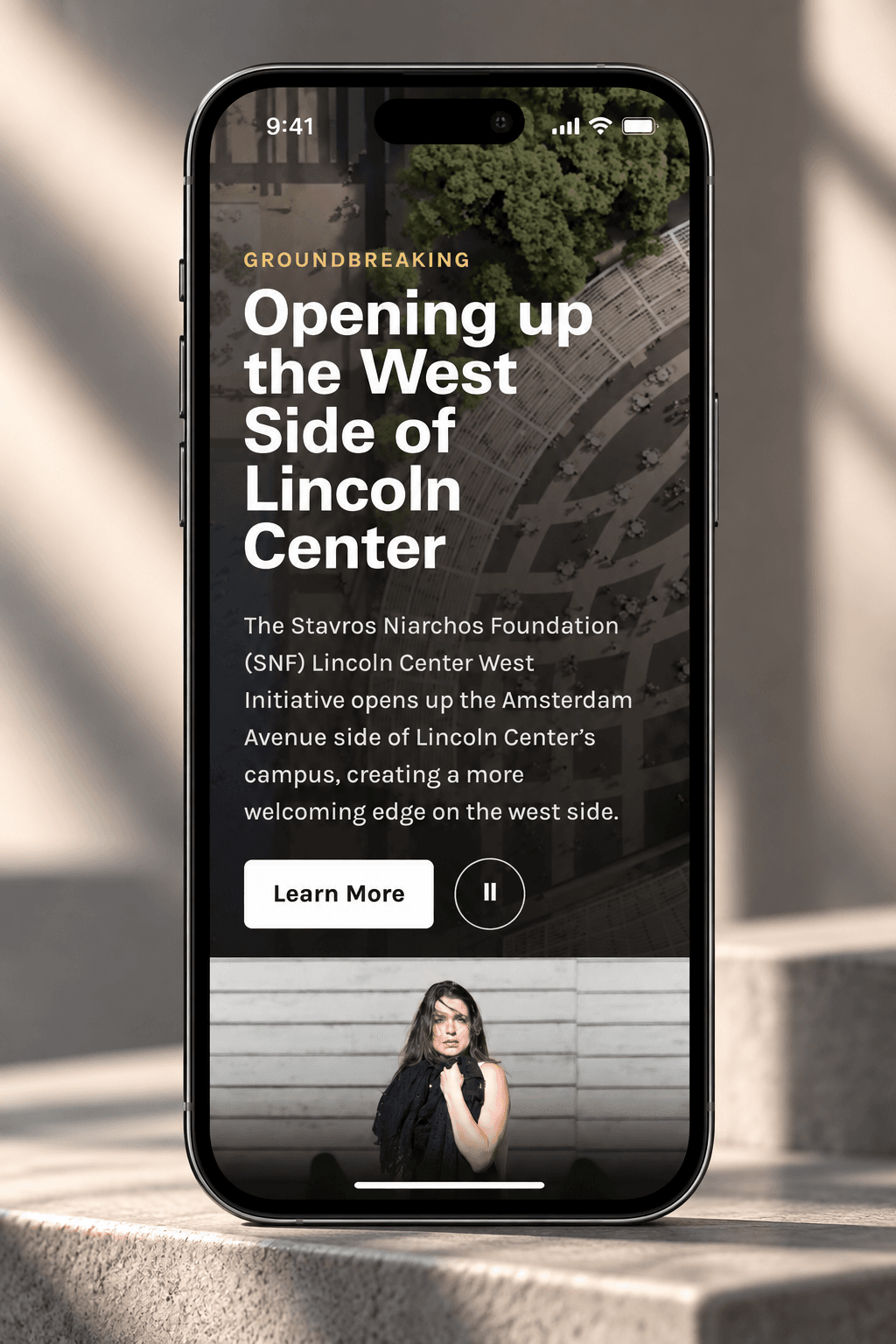
Lincoln Center West Side editorial story shown on a front-facing mobile phone
Mobile-first institutional storytelling

Event discovery is essential, but it is not the full Lincoln Center story. The prototype introduces editorial pathways for history, public purpose, the evolving campus, and the institution’s relationship with New York City.

Stories including San Juan Hill, the West Project, public-space initiatives, artists, and education are integrated into the audience journey rather than isolated in a section few visitors will discover.

A multi-organization campus

One destination without erasing the institutions within it.

LincolnCenter.org already operates as an important discovery and referral layer for the broader campus. In 2025, it drove approximately 1.4 million outbound clicks to Resident Arts Organization websites.

The new concept incorporates those organizations into curated campus-wide contexts while preserving attribution, institutional identity, and clear onward pathways.

  1. 01Audiences often experience Lincoln Center as one destination.
  2. 02The organizations within that destination remain distinct institutions.

From concept to product

The prototype became both a design artifact and an alignment tool.

I developed the homepage as a high-fidelity responsive product rather than a series of static design files. Stakeholders could scroll through its narrative, follow links, evaluate content density, and understand how the modules worked together.

The prototype made strategic conversations more productive. Instead of discussing abstract preferences, teams could respond to a shared, tangible experience.

  • Content hierarchy and editorial pacing
  • Responsive behavior and motion
  • Pathways into event discovery
  • Cross-campus representation
  • Reusable component behavior
  • Adaptability across seasons and initiatives

A connected digital front door

Inspiration and comprehensive discovery, designed as complementary products.

The homepage and Global Calendar were designed together because they serve different audience needs. The homepage creates inspiration, context, and curated entry points. The calendar supports comprehensive, intent-driven discovery.

Together, they create a coherent path from initial interest to a relevant event or experience, while connecting to a broader roadmap for the app, saved events, visitor planning, shared components, and audience insight.

Flexible by design

A durable system for changing stories and a future brand.

The prototype is built around reusable interface components rather than fixed promotional layouts. The system creates consistency without making every story look the same.

Shared patterns establish predictable structure, interaction, accessibility, and behavior while allowing imagery, typography, color, and emphasis to adapt across seasons, festivals, campaigns, sponsorships, and future institutional identity changes.

  • Semantic structure and logical heading hierarchy
  • Keyboard interaction and visible focus behavior
  • Reduced-motion support and alternatives to motion
  • Responsive typography and sufficiently sized controls
  • Image optimization and performance-aware media
  • Screen-reader-friendly content order

Measuring success

From inspiration and orientation to meaningful action.

The question is not simply whether people remain on the homepage longer. It is whether the experience helps them understand Lincoln Center, discover something relevant, and take a meaningful next step.

As the product moves toward a January 2027 launch, measurement will connect engagement with featured content to downstream discovery, event views, outbound referrals, visitor-information use, accessibility, and performance.

  • Movement from the homepage into the Global Calendar
  • Event-detail views from homepage modules
  • Ticket and Resident Arts Organization referrals
  • Cross-campus and editorial exploration
  • Mobile engagement and interaction completion
  • Scroll depth, return visits, accessibility, and performance

Current outcome

A broad institutional ambition made tangible and buildable.

The working prototype established the foundation for a January 2027 launch and gave stakeholders a tangible way to evaluate the relationship between programming, editorial content, organizational visibility, sponsorship, and audience utility.

Presented across institutional and cross-campus groups, it now guides feedback, prioritization, content requirements, component development, responsive behavior, accessibility, and the relationship between the homepage and the Global Calendar.

Reflection

The central challenge was not determining what to place on the homepage. It was determining what the homepage was for.

The product became clearer once the homepage was defined as an audience journey rather than a collection of institutional requests. The final direction creates room for discovery, storytelling, organizational visibility, and change while establishing a flexible foundation for Lincoln Center’s next chapter.