Product Strategy · Experience Design · Prototyping

Global Event Discovery & Calendar

Reimagining how audiences discover everything happening across Lincoln Center.

View working prototype
Organization
Lincoln Center for the Performing Arts
Status
In Development · Launching November 2026
Role
Product and Design Lead
Period
In development · November 2026 launch
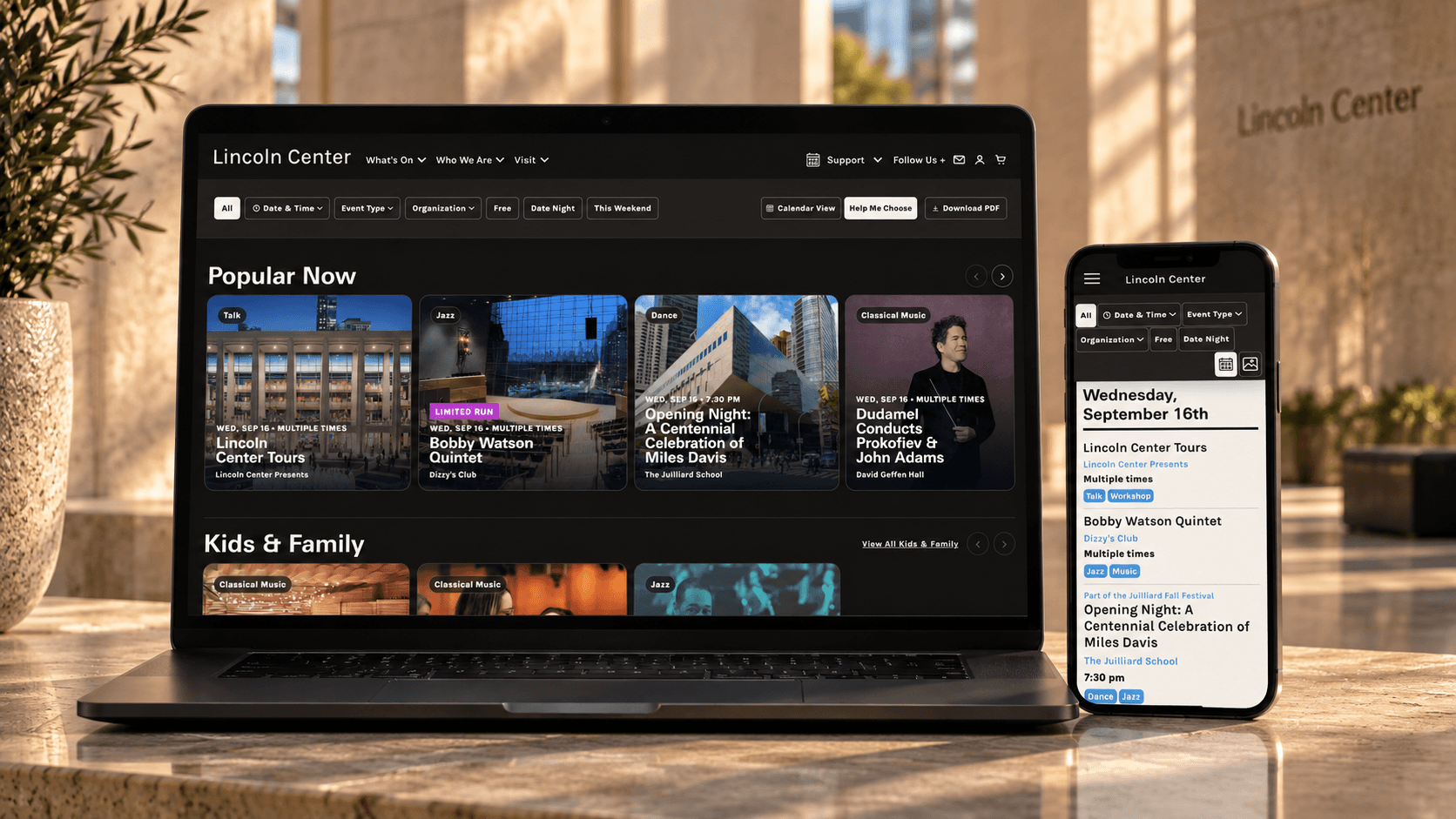
Global Calendar discovery experience shown on a laptop and mobile phone in a warm Lincoln Center–inspired setting
Discovery across desktop and mobile

Overview

A calendar redesigned as an audience product.

Lincoln Center presents an extraordinary breadth of performances, programs, and public experiences across its campus. Yet the primary tool for discovering those events had become difficult to navigate, visually constrained, and especially challenging to use on mobile devices.

I led the complete reimagining of LincolnCenter.org’s Global Calendar as a unified, mobile-first discovery experience. The goal was larger than redesigning a calendar. We needed to create a more intuitive digital gateway to the Lincoln Center campus, one capable of helping audiences move quickly from curiosity to a performance, program, or experience that felt personally relevant.

The result is a working, imagery-led prototype that simplifies browsing, introduces clearer pathways through a complex programming ecosystem, and establishes a scalable foundation for richer storytelling, personalization, and audience engagement.

The existing audience opportunity

An established behavior with room to become far more useful.

240K
active calendar users2025 baseline
~1M
calendar-content interactions2025 baseline
1.4M
outbound clicks to Resident Arts Organizationsbroader 2025 ecosystem

My role

Product and Design Lead

I worked across product, design, engineering, marketing, programming, analytics, and institutional stakeholders to create a direction that could serve audiences while accommodating the realities of a complex cultural organization.

In collaboration withMarketing · Engineering · Advancement & Innovation · Programming · Analytics · Institutional stakeholders

  • Defining the product vision and experience principles
  • Translating organizational complexity into a coherent audience experience
  • Leading cross-functional discovery and stakeholder working sessions
  • Mapping audience journeys and identifying points of friction
  • Evaluating competitive and best-in-class discovery experiences
  • Restructuring the calendar’s information architecture and taxonomy
  • Designing the responsive user experience and visual interface
  • Building a high-fidelity working prototype
  • Presenting the product vision and gathering stakeholder feedback
  • Establishing success measures for future launch and optimization
  • Connecting the calendar to the broader homepage, mobile, storytelling, and digital-platform strategy

Experience principles

Six ideas held the system together.

  1. 01Make complexity feel simple
  2. 02Begin with audience intent
  3. 03Design for the smallest screen first
  4. 04Let programming carry the experience
  5. 05Build a system, not a seasonal redesign
  6. 06Connect discovery to action

The challenge

Extraordinary breadth had become a discovery problem.

What can I see at Lincoln Center?

Lincoln Center is not a single venue with a single stream of programming. It is a complex cultural ecosystem encompassing Lincoln Center Presents, numerous performance spaces, free and ticketed events, festivals, educational programming, public experiences, and the work of its Resident Arts Organizations.

For audiences, this breadth is one of Lincoln Center’s greatest strengths. Digitally, however, it creates a significant discovery challenge. The existing calendar had accumulated years of interface decisions, content requirements, and organizational complexity. It presented users with a dense, utilitarian experience that was particularly difficult to navigate on mobile.

The calendar functioned as a listing tool, but it did not adequately express the energy, variety, or cultural richness of the campus. Because it was already one of the most important entry points in Lincoln Center’s digital ecosystem, improving discovery could influence usability, audience engagement, institutional visibility, cross-campus exploration, and ticket conversion.
Discovery and definition

Stepping away from the interface to understand the real problem.

Through two cross-functional workshops, journey mapping, taxonomy exercises, card sorting, competitive analysis, and stakeholder conversations, we explored how different audiences approach event discovery and where the current experience created unnecessary friction.

Some visitors arrive knowing exactly what they want to see. Others begin with a date, an art form, a venue, an organization, a price point, or simply the desire to do something interesting in New York City. The experience needed to support direct, intentional paths while also making room for exploration and surprise.

The discovery process transformed the project from an interface redesign into a broader product strategy for campus-wide event discovery.

  • How might we help someone find a relevant event as quickly as possible?
  • How might we make an extensive programming calendar feel inspiring rather than overwhelming?
  • How might we represent the full campus without erasing the identity of its individual organizations?
  • How might we make mobile discovery feel natural and efficient?
  • How might we create a foundation that can evolve as personalization and new forms of event discovery become more central?

Mobile-first interaction

Useful controls, designed for thumbs rather than shrunk from desktop.

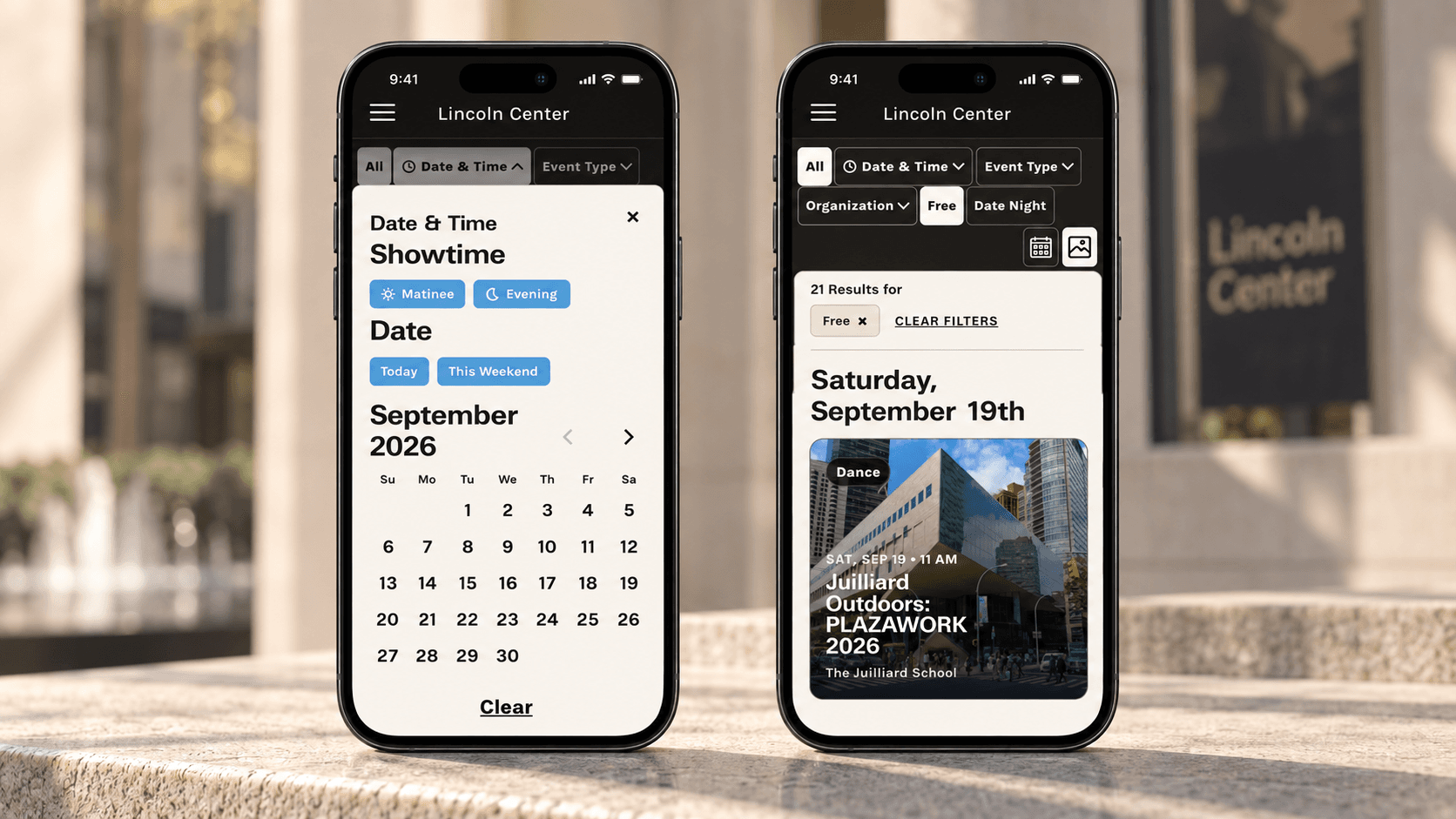
Date selection and filtering become focused, legible tasks on the smallest screen.

Date selection and free event discovery shown on two front-facing mobile phones
Date selection and filtered discovery

The product vision

From dense event listing to an inviting campus-wide discovery experience.

The product introduces a clearer visual hierarchy, stronger event imagery, simplified navigation, and more intuitive ways to move through an extensive range of programming. The design balances fast, directed discovery with the opportunity to browse across dates, genres, venues, series, and participating organizations.

Rather than forcing every event into an identical presentation, the system creates consistency while allowing the distinguishing details of each experience to remain visible.

The prototype uses representative event data rather than live API integrations, but its filtering, date navigation, and interactive behaviors are fully functional. This allowed the team to evaluate the intended discovery experience before connecting it to Lincoln Center’s production event-data ecosystem.

  • A mobile-first, responsive interface
  • Clear date-based browsing and navigation
  • More intuitive filtering and browsing
  • Flexible event cards with stronger visual hierarchy
  • Scannable dates, times, venues, event types, and ticket information
  • Clear pathways to event details and ticketing
  • Support for free, choose-what-you-pay, and traditionally ticketed experiences
  • Dedicated festival and series calendars
  • Reusable components adaptable to different programming and brand contexts
  • A foundation for future personalization and intelligent discovery
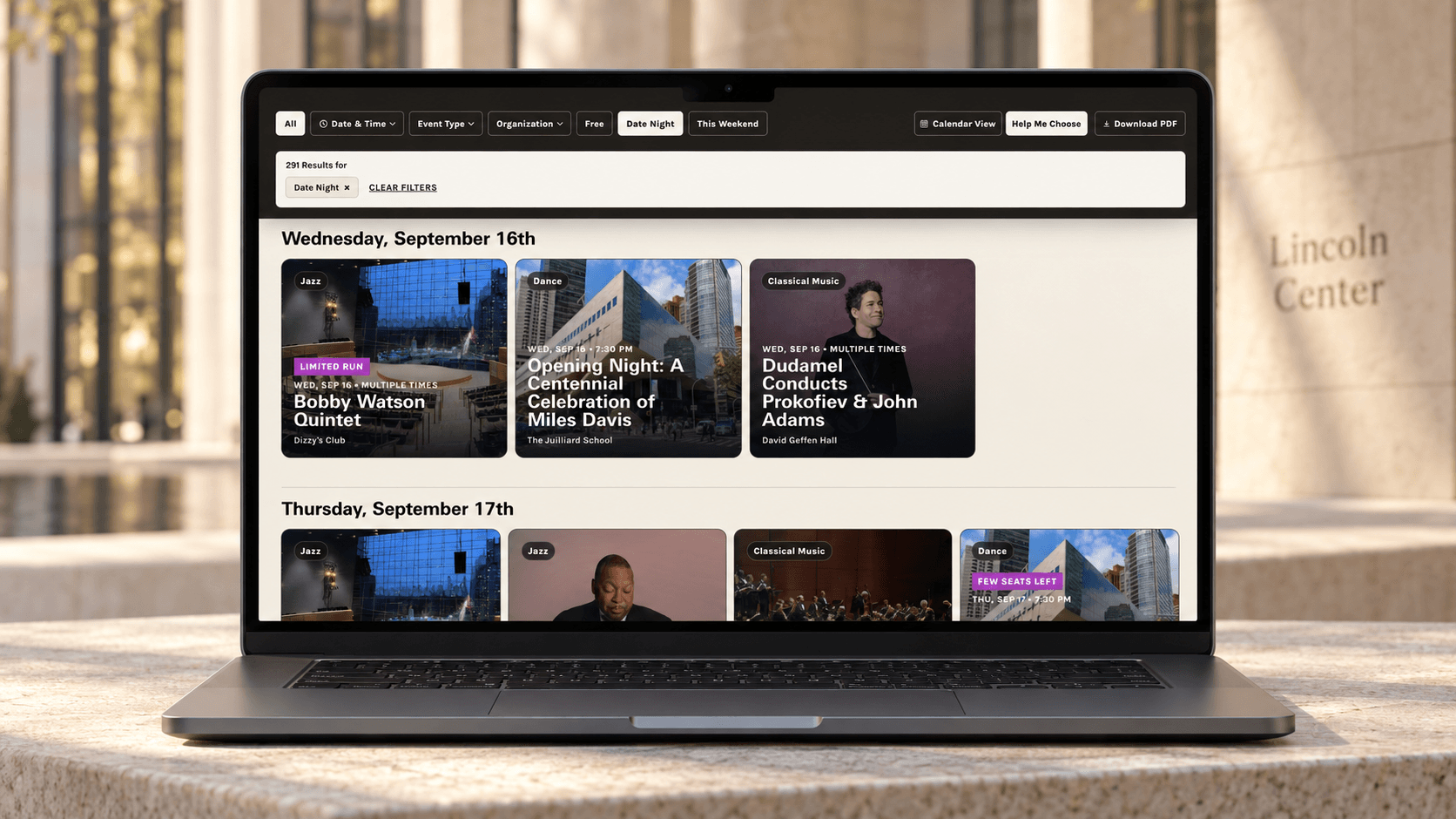
Date Night filtered event discovery shown on a front-facing laptop
Directed discoveryDate Night results retain visual energy while making the active filter unmistakable.

Designing across an ecosystem

One campus experience without flattening the institutions behind it.

Lincoln Center acts as both a presenter and a gateway to the work of independent Resident Arts Organizations. Audiences may not always understand those organizational distinctions, but the distinctions still matter for branding, content ownership, event information, and ticketing.

This required product thinking beyond the interface. Information hierarchy, taxonomy, event metadata, organizational attribution, calls to action, and downstream ticketing behavior all had to work together as one comprehensible system.

  1. 01Present the campus as a coherent cultural destination.
  2. 02Preserve clear attribution and pathways to the organization presenting each event.
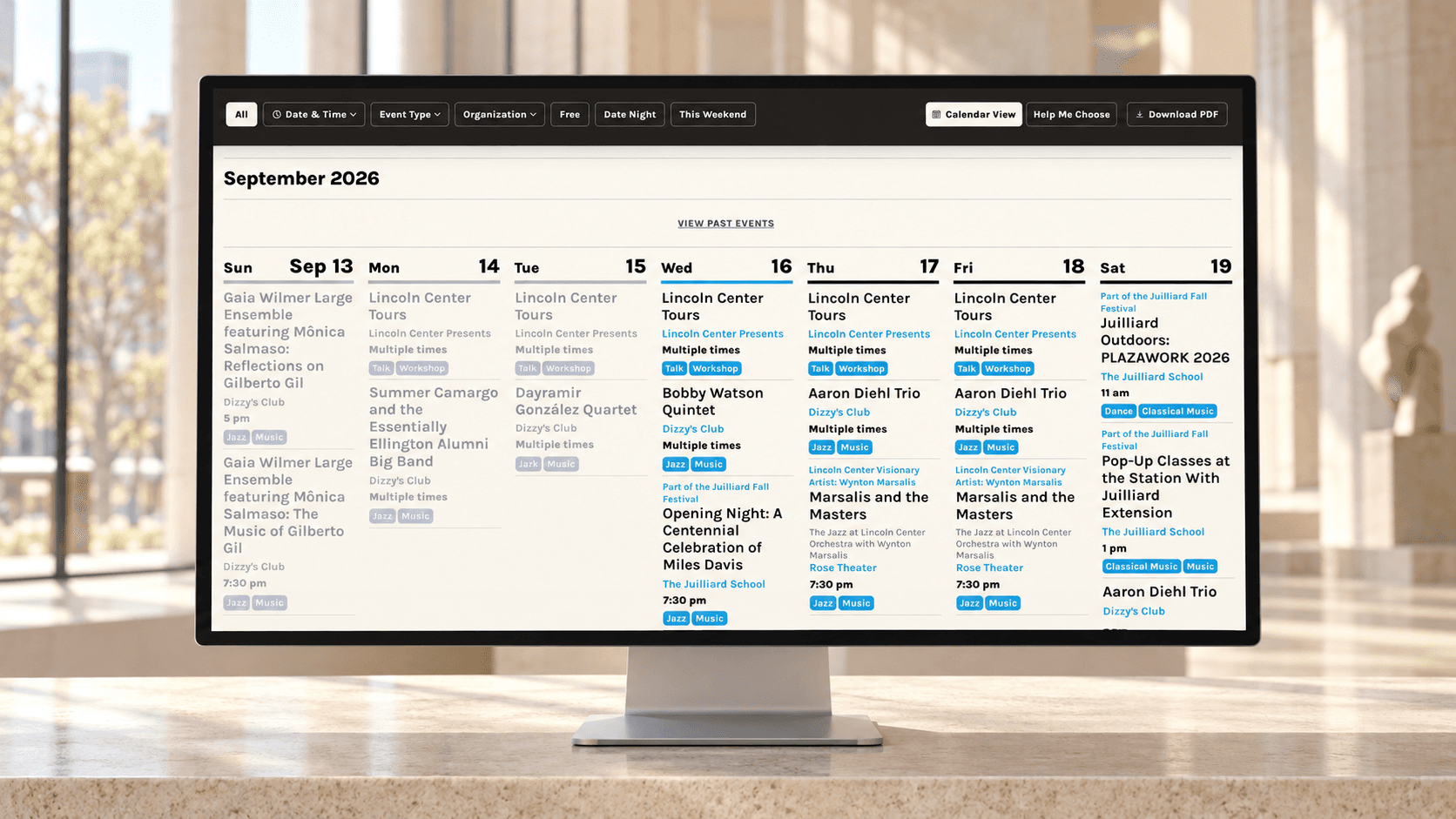
Weekly calendar view shown on a front-facing desktop monitor
Multiple ways to browseA dense calendar view supports audiences who begin with a date.

From strategy to working product

The prototype became the alignment tool.

A static design would not have been enough to evaluate an experience with this much interaction, responsive behavior, and information complexity.

I developed the concept as a high-fidelity working prototype with functional filtering, date navigation, calendar actions, responsive layouts, and reusable interface patterns. Although it uses representative data, stakeholders and development teams can experience the proposed product directly rather than interpreting it through static screens.

Building the prototype helped close the distance between design intent and technical execution. Product questions surfaced earlier, interaction decisions became more concrete, and the team could assess the experience as a connected system.

  • Evaluate the experience across desktop and mobile
  • Test the hierarchy and density of event information
  • Demonstrate browsing and filtering behaviors
  • Identify content and metadata requirements
  • Gather more useful stakeholder feedback
  • Explore campaign and series-specific treatments
  • Create a tangible basis for engineering estimates and implementation planning

A broader digital foundation

Designed as a central layer, not another isolated product.

The Global Calendar was designed in parallel with a reimagined LincolnCenter.org homepage. Together, they form the foundation of a more cohesive digital front door. The homepage creates inspiration, institutional context, and editorial pathways. The calendar provides depth, utility, and comprehensive event discovery.

This systems-level view ensures that audiences can move fluidly between featured programming and the full breadth of activity across the campus while creating a foundation for longer-term audience initiatives.

  • Editorial storytelling pathways
  • Personalized recommendations
  • Saved events and audience profiles
  • Mobile-app integration
  • Loyalty and rewards
  • Connected pre-visit and post-visit experiences
  • Improved first-party audience insight

Accessibility and scalability

A core product requirement, not a final compliance exercise.

The experience was designed around semantic structure, keyboard navigation, visible focus behavior, readable information hierarchy, sufficiently sized interactive controls, descriptive interface language, and interactions that do not depend exclusively on hover or visual cues.

The component-based approach creates a more sustainable accessibility foundation. Shared patterns can be tested, improved, and governed consistently rather than recreated independently across pages and campaigns.

Its content and presentation layers can also evolve without requiring the underlying discovery experience to be rebuilt, creating flexibility for new programming models, seasonal identities, and Lincoln Center’s future brand expression.

Measuring success

Separating traffic from successful discovery.

With the redesigned calendar now in formal development for a November 2026 launch, the measurement strategy will evaluate whether the finished product improves both discovery and meaningful audience action.

  • Calendar visits and engaged sessions
  • Events viewed per session
  • Use of filters and date navigation
  • Movement from calendar results to event-detail pages
  • Ticket and outbound organization clicks
  • Add-to-calendar and sharing actions
  • Exploration across series and Resident Arts Organizations
  • Mobile engagement and task completion
  • Bounce and exit rates
  • Time required to find a relevant event

Current outcome

A bridge between strategy, design, alignment, and delivery.

The working prototype established a shared, tangible vision for the future of event discovery at Lincoln Center and provided the foundation for a formal product-development initiative scheduled to launch in November 2026.

It transformed an abstract modernization effort into a product that stakeholders could navigate, evaluate, and understand. The functional prototype clarified interaction requirements, content and metadata needs, responsive behavior, reusable component patterns, and the future relationship between the interface and Lincoln Center’s event APIs.

As the product moved into development, the prototype became more than a presentation tool. It served as a bridge between strategy, design, stakeholder alignment, and technical delivery.

Most importantly, the work reframed the calendar from a functional schedule into one of Lincoln Center’s most important audience products: a digital expression of everything happening across the campus and a primary path from curiosity to participation.

Reflection

The most important design work in this project was not deciding how an event card should look. It was finding clarity within a complicated institutional ecosystem.

The final direction succeeds because it respects that complexity without transferring it to the audience. It creates a unified experience without erasing individual organizations, supports direct tasks without eliminating discovery, and delivers immediate utility while establishing a foundation for a much more intelligent and connected digital future.