Product Strategy · Experience Design · Content Automation

Story Share

Transforming event pages into a scalable social-content engine.

Organization
Lincoln Center for the Performing Arts
Status
Launched August 2026
Role
Product and Design Lead
Period
August 2026 launch
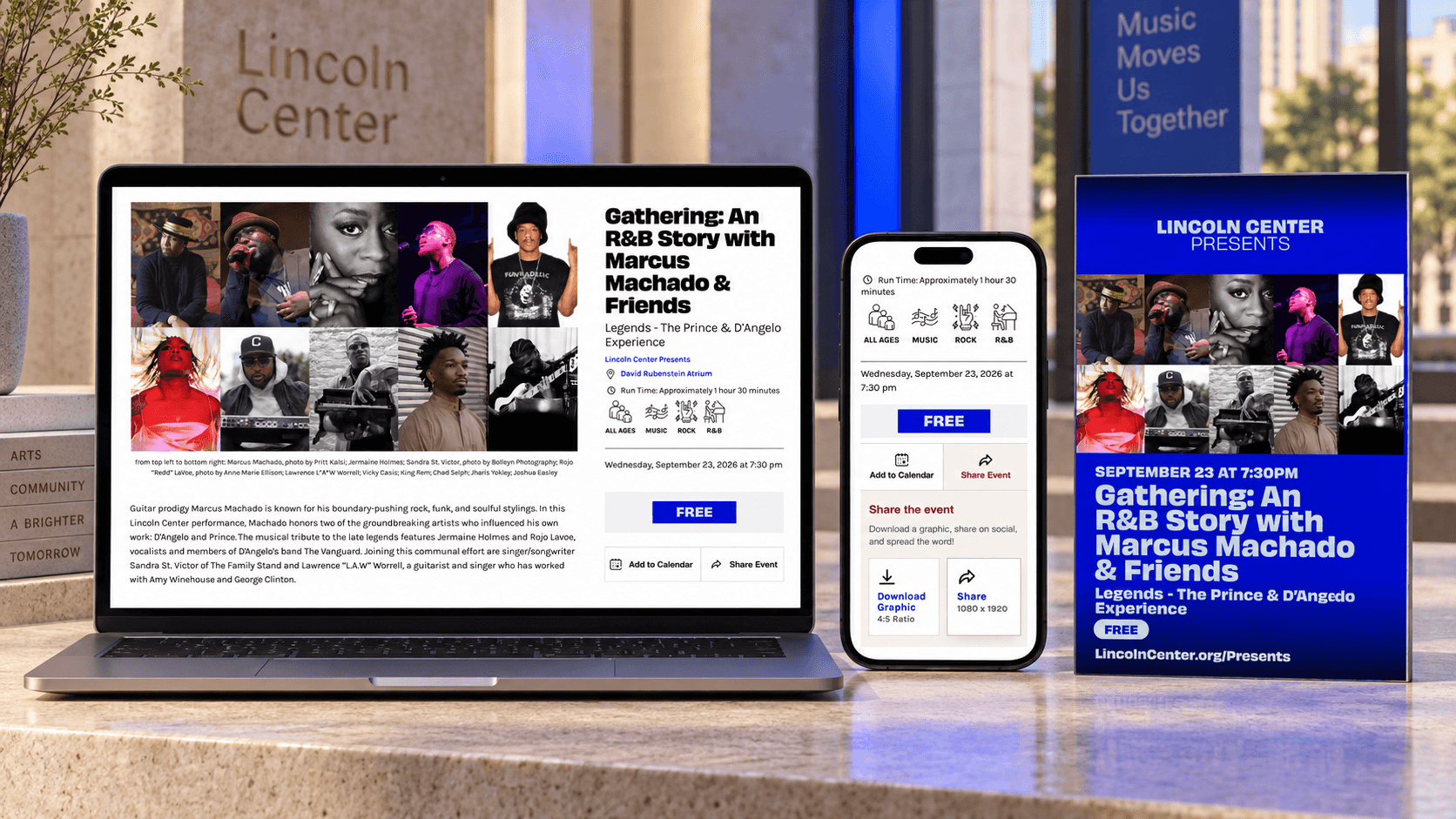
Story Share shown across an event page, mobile sharing flow, and finished social graphic
One connected path from event information to audience-ready content

Overview

Every event page became a source of polished, shareable content.

Every Lincoln Center performance has the potential to inspire an audience member to share what they are seeing, attending, or looking forward to. Yet creating polished, event-specific social content required considerable manual effort from internal teams, while patrons had no simple way to generate attractive, accurate graphics directly from an event page.

I designed and launched Story Share, a self-service product that transforms Lincoln Center event information into polished, brand-aligned social graphics.

From an event page, users can create and share an Instagram Story or download a formatted graphic for use across social and messaging platforms. Event imagery, titles, dates, venues, and supporting information are assembled within a consistent visual system, allowing each asset to feel intentional without requiring a designer to create it individually.

The product turns existing event data into a reusable content engine. It gives audiences an easier way to advocate for the performances they love while eliminating a repetitive production workflow estimated to consume hundreds of staff hours.

A small product with compounding value

One shared system replaced a high-volume manual production loop.

~27
shows in the initial rolloutAugust 2026 launch
100s
staff hours estimated to be recoveredrepeat production
2
connected sources of valueaudience advocacy and operational efficiency

My role

Product and Design Lead

I led Story Share from product definition through experience design, requirements development, launch planning, and delivery, connecting product, design, content, marketing, and technology within one system.

In collaboration withMarketing · Engineering · Advancement & Innovation · Creative · Content teams

  • Identifying the manual workflow and broader audience opportunity
  • Defining the product vision and initial scope
  • Mapping event data to generated assets
  • Designing the end-to-end responsive experience
  • Creating the visual system for social graphics
  • Defining content rules and edge-case behavior
  • Partnering with development and marketing stakeholders
  • Managing prelaunch requests and protecting the delivery timeline
  • Defining adoption, referral, and efficiency measurement

Experience principles

Six principles turned a design request into a scalable product.

  1. 01Make sharing effortless
  2. 02Use the event page as the source
  3. 03Protect the brand automatically
  4. 04Design for mobile behavior
  5. 05Standardize the common path
  6. 06Let audiences extend the story

The challenge

Valuable creative work had become difficult to scale.

How might we turn every eligible event page into a source of polished, shareable content without creating more work for internal teams?

Lincoln Center presents a large and continually changing volume of performances, festivals, public programs, and special events. Each event creates demand for social content across announcements, reminders, cross-promotion, artist support, and audience sharing.

A single event graphic may not require significant time. Repeating the process across dozens of events, formats, and requests creates a substantial operational burden, along with opportunities for inconsistent branding, outdated information, duplicated effort, and last-minute production pressure.

At the same time, audiences increasingly discover cultural experiences through other people. A patron sharing an upcoming performance with friends can become one of the most credible and effective forms of promotion.

  • Make it easier for audiences to share Lincoln Center events
  • Reduce repetitive graphic production for internal teams
  • Maintain visual and informational consistency
  • Extend the organic reach of programming
  • Transform event pages into active points of audience advocacy
  • Support many events through one scalable system
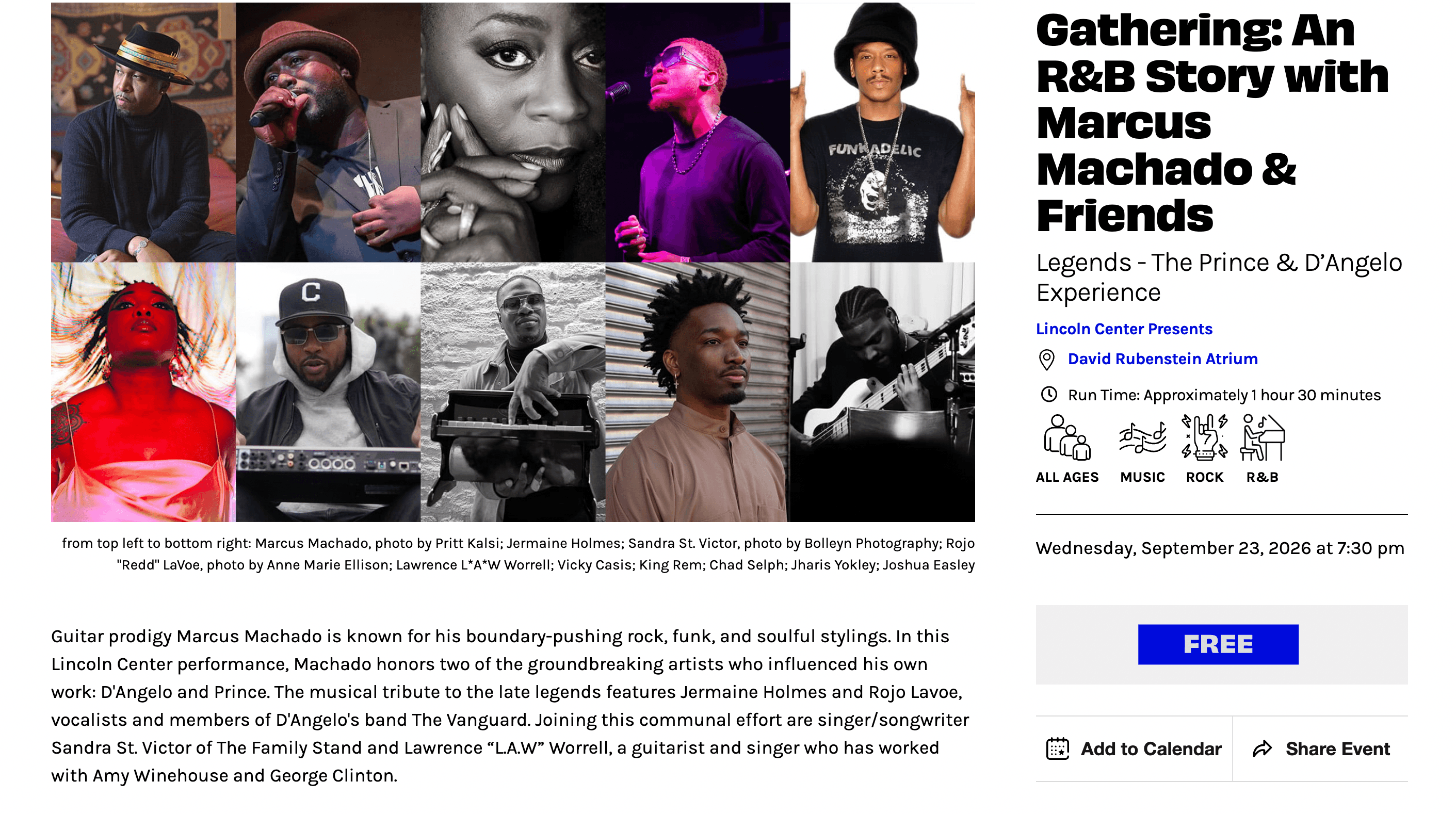
Understanding the workflow

Automation required translating design judgment into rules.

The project began with a deceptively simple request: make it easier to share events. The underlying problem was more complex.

Events can have short or long titles, multiple dates, subtitles, series affiliations, different ticketing models, changing imagery, and unique promotional requirements. The existing manual process handled these differences through individual design judgment. Automation required us to determine which decisions could become rules.

A scalable product did not need to eliminate every exception. It needed to automate the standard experience extremely well while creating an intentional path for cases that required custom treatment.

  1. 01Repeatable information: title, subtitle, date and time, venue, imagery, presenting organization, and brand treatment.
  2. 02Exceptional information: unusual date ranges, complex naming, custom campaign language, missing imagery, and distinct visual identities.

Integrated at the point of interest

The event page becomes both the source and the invitation to share.

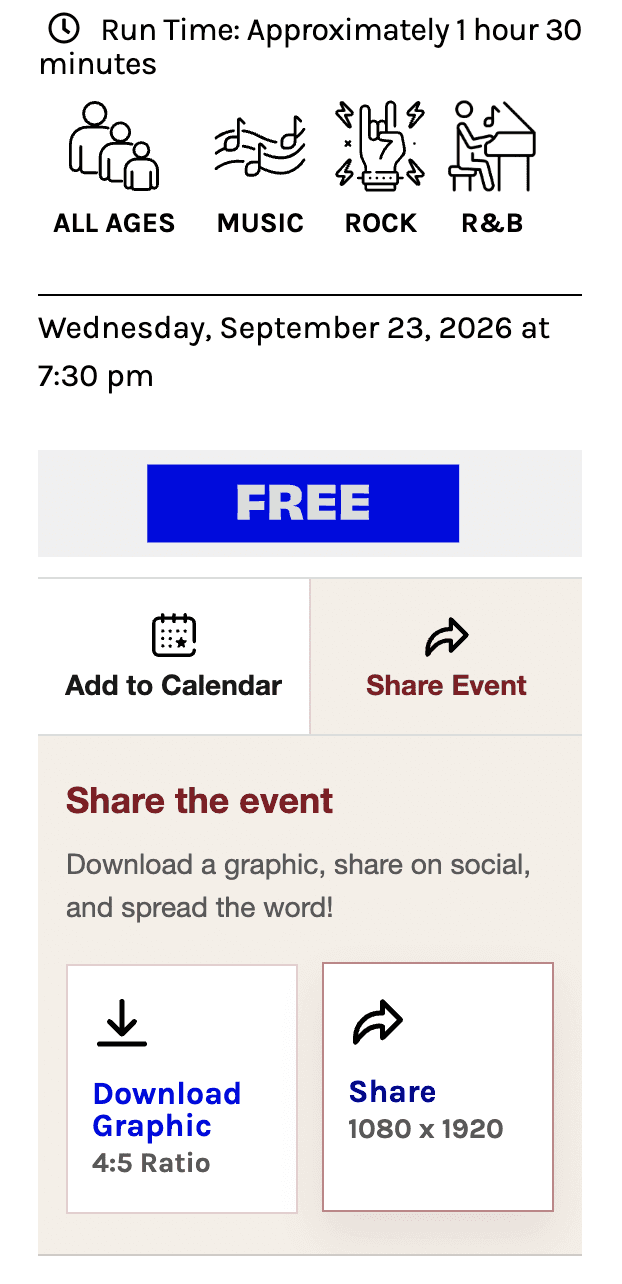
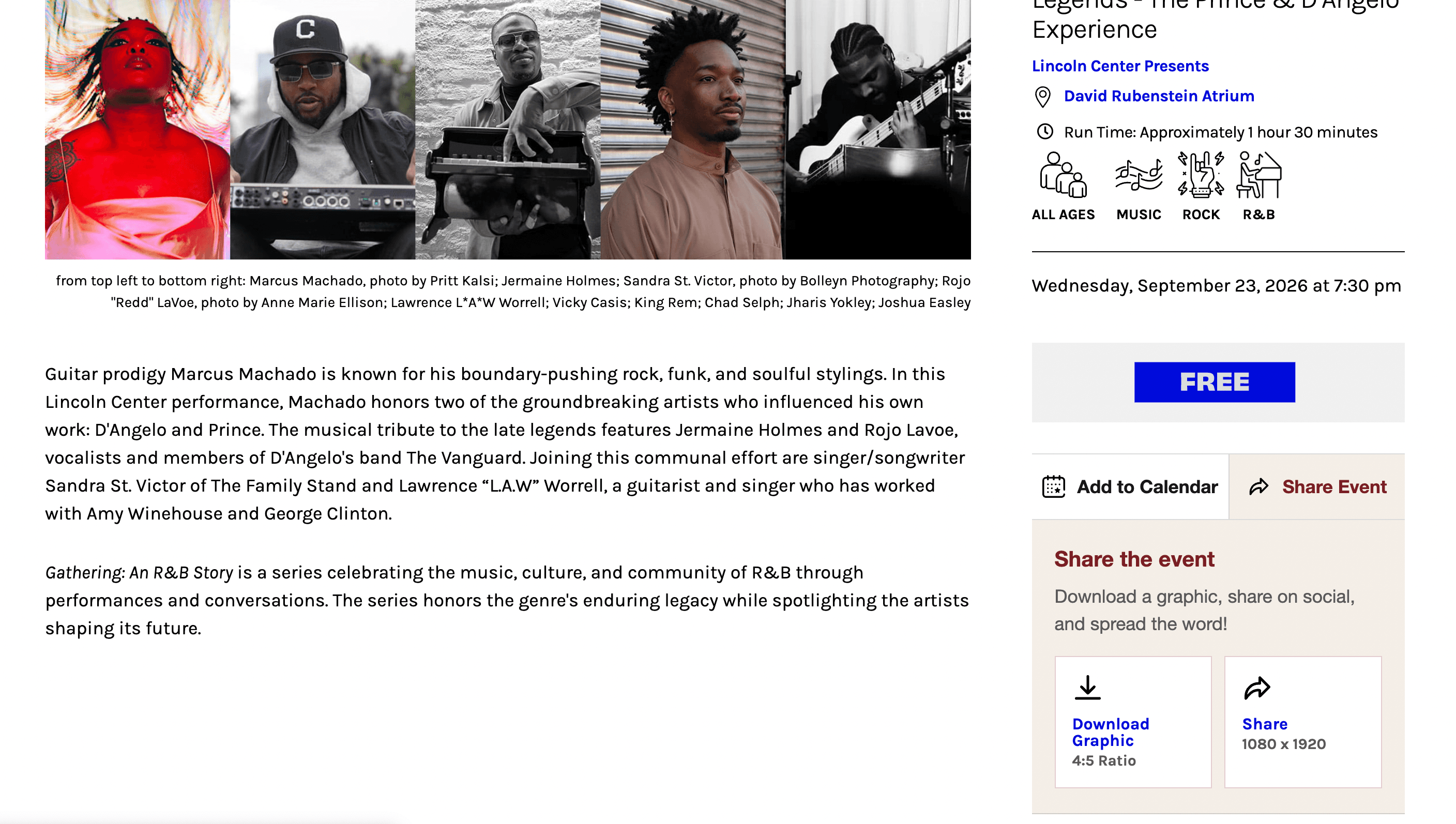
Desktop Lincoln Center event page with Story Share actionMobile Story Share panel with download and social sharing actions
Responsive sharing within the existing event experience

The product experience

Sharing appears at the moment of greatest audience interest.

Story Share is integrated directly into Lincoln Center event pages. A user can select the sharing option, preview a professionally designed event graphic, and create an asset using information already associated with the performance.

The product does not ask the user to design anything. The creative decisions have already been built into the system. Story Share is a self-service product, but it is not a generic design tool. Its purpose is to generate a highly specific, useful, and brand-safe result with minimal effort.

  • Vertical graphics designed for Instagram Stories
  • Downloadable assets for social posts and messaging
  • Event-specific imagery and information
  • Consistent treatment of titles and subtitles
  • Dates, venues, and relevant event details
  • Brand-aligned typography and composition
  • A mobile-first preview and generation experience
  • A repeatable structure that adapts across programming

Designing the visual system

Variation without unpredictable results.

Automated content generation introduces a fundamental design challenge. Event titles occupy different amounts of space, images have different focal points and contrast, dates vary in complexity, and some events require subtitles while others do not.

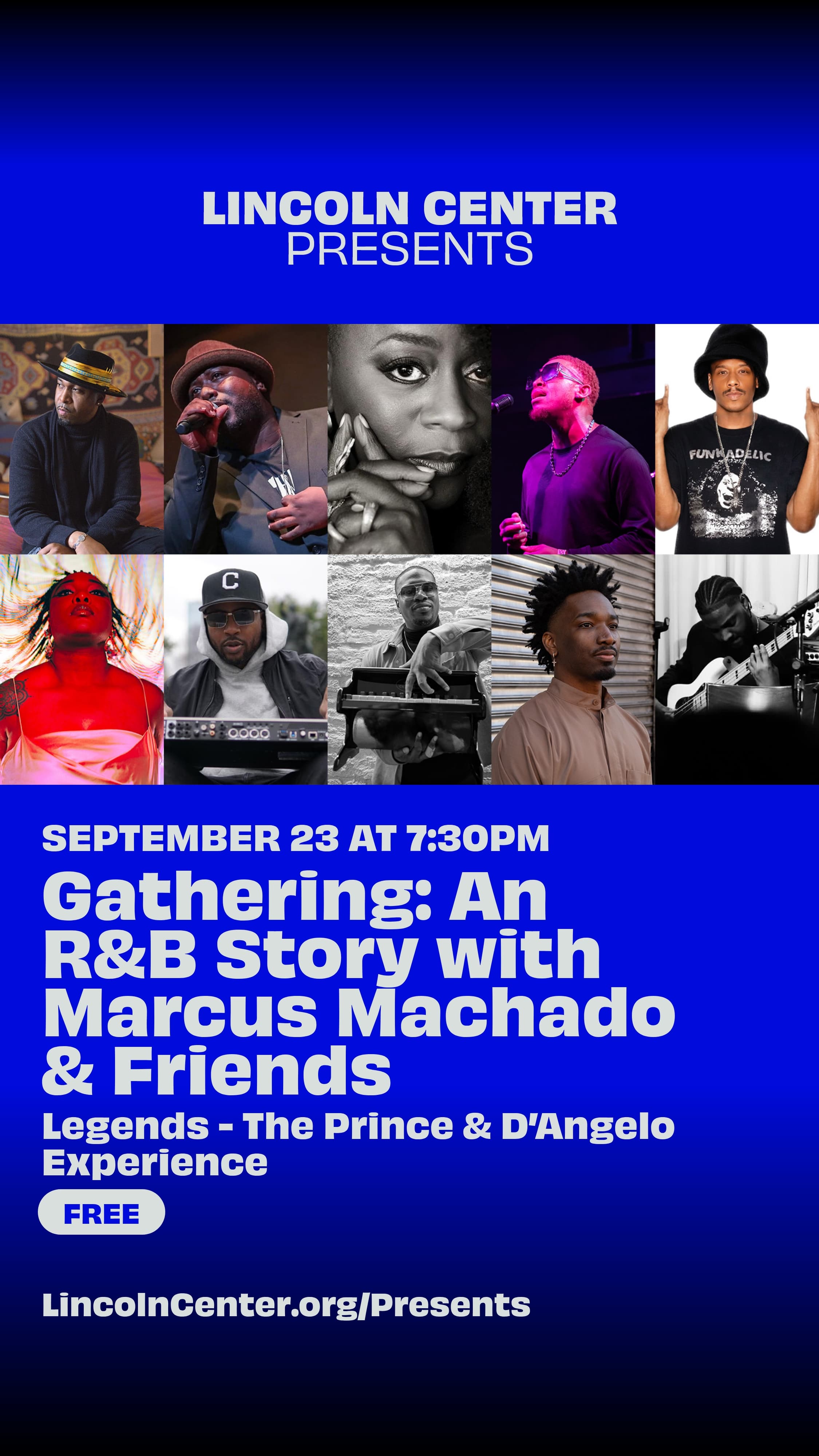
I designed Story Share as a constrained visual system rather than a collection of individual templates. Rules for image cropping, typography, metadata, spacing, alignment, brand presence, and information density allow a wide range of programming to move through the same product while producing assets that still feel considered and intentional.

Because the visual and content rules are embedded into the experience, users do not need to interpret brand standards each time they create a graphic.

Desktop event page showing the Story Share panel alongside event contentGenerated vertical Lincoln Center Presents social graphic
Rules become outputThe event’s content and imagery are transformed into a polished, brand-aligned asset.

Managing complexity without delaying launch

Clear boundaries protected accuracy, quality, and timing.

As Story Share approached launch, additional requirements emerged across the initial group of approximately 27 shows. Visibility across eligible events and persistent subtitle treatment aligned with the product’s standard behavior. Complex date ranges presented a different challenge.

Supporting every possible event structure would have required additional development immediately before launch. Instead, I established a clear exception path. Events that could not be represented accurately could temporarily disable Story Share and use a custom graphic while more flexible support was considered for a future iteration.

Attempting to solve every edge case in the initial release would have delayed value for the majority of events. Scalable systems become stronger when their boundaries are understood.

  1. 01Protect the accuracy of public event information.
  2. 02Protect the quality of generated assets.
  3. 03Protect the August launch timeline.

Audience and operational value

One product creates value on both sides of the experience.

For audiences, Story Share reduces the distance between discovering an event and inviting someone else into that experience. A patron can become an advocate without searching for an image, taking a screenshot, or manually assembling event information.

For internal teams, the same system reduces the need to create and distribute individual social assets. Teams can spend less time on repetitive production and more time on higher-value storytelling, campaigns, and strategy.

For the institution, every shared graphic extends programming into personal social networks while preserving accurate information and a consistent Lincoln Center identity.

A different kind of content automation

The highest-value automation connected capabilities that already existed.

Story Share demonstrates that automation does not need to begin with generative AI or an entirely new content platform.

The product connects structured event information, approved imagery, a defined visual system, and an audience motivated to share. It applies design and business rules to those inputs and produces a reliable asset at the moment it is needed.

The audience sees a polished expression of the event. Behind that experience is a structured product eliminating a considerable amount of invisible manual work.

  1. 01Structured event information
  2. 02Approved event imagery
  3. 03A defined visual system
  4. 04An audience motivated to share

Measuring success

Audience advocacy and organizational efficiency belong in the same framework.

The measurement strategy evaluates both audience behavior and operational value. Identifying which performances audiences choose to share can also reveal where personal enthusiasm and organic advocacy are strongest.

Because the product launched recently, long-term adoption and conversion data are still developing. The operational model is estimated to eliminate hundreds of hours of repetitive production work while expanding Lincoln Center’s capacity to generate branded event content.

  • Interaction with Story Share on event pages
  • Graphics generated and share or download completion
  • Engagement by device and format
  • Social referral traffic and downstream ticketing behavior
  • Distribution of use across eligible events
  • Reduction in manually produced social assets
  • Estimated staff production time saved
  • Adoption by internal content and marketing teams

Current outcome

A focused product that turns repetition into compounding value.

Story Share launched for Lincoln Center Presents in August 2026, with the initial rollout designed to support approximately 27 shows.

Eligible event pages can now generate polished social assets through a shared visual and content system rather than relying exclusively on individually designed graphics. The launch established a new audience-sharing capability, greater consistency, reduced dependence on repetitive production, a framework for managing exceptions, and a foundation for measuring advocacy and referral behavior.

Story Share does not attempt to replace every custom campaign asset or solve every social-publishing need. It automates a high-volume, repeatable workflow where consistency and speed create meaningful value.

Reflection

Product impact is not always proportional to product size.

The strongest part of Story Share is the connection between internal efficiency and audience participation. By turning existing event data into audience-ready content, the product allows Lincoln Center’s programming to travel further while asking less of the people responsible for promoting it.